


AI sometimes feels like magic, doesn’t it? It promises to deliver incredible, game-changing results. And the hype is real, with nearly every company implementing AI everywhere, all at once, as shown in a Celonis survey where nearly 80% of respondents plan to have an AI use case in the next 12 months.

Today, I want us to take a step back and ask a critical question: Are we solving real problems, or are we just playing with shiny toys?
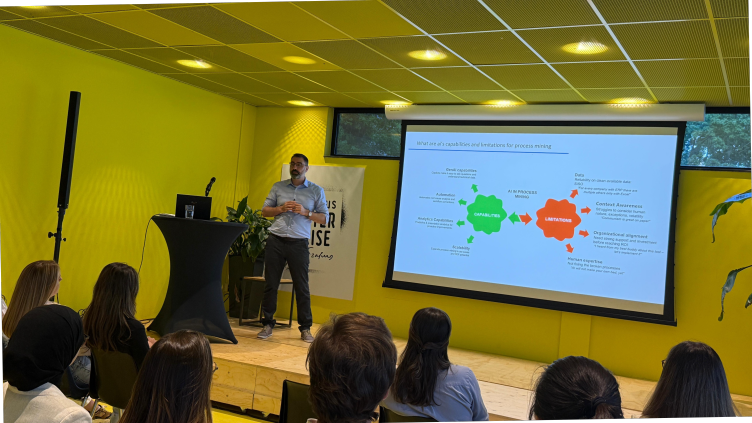
I won’t spend time listing all the AI capabilities in process mining—we’ve got experts who know the details better than I ever could. Instead, I want to focus on of the capability I believe deliver the most value. GenAI copilots.
GenAI copilots are the real game changer for process mining, making the technology available to everyone and enabling much faster results. I’m old, I was there when only special experts could untangle the process spaghetti, and it took a long time to figure out what was happening and what the impact was. Today, it’s as simple as having a conversation with a copilot.

But my main role in the conference is to bring you back to reality, so let’s talk about the limitations.
First, let’s start with the obvious: Data. It’s clear that without clean data, there’s no real visibility. But it goes deeper than that. AI frequently lacks access to critical, undocumented data. In many organizations, key processes are still managed in Excel spreadsheets, pen-and-paper notes, or in the heads of employees who’ve been there for 10 or 20 years without documenting their workflows. AI can only access what has been captured.
This brings me to my second point: on paper or in the system, a process might look lean and efficient, but in reality, the results are far from ideal. It’s just like communism: it sounds great in theory, but has terrible results. Context is key in everything, and AI struggles to account for human quirks, exceptions, and unwritten rules that are deeply embedded in how work actually gets done. You can’t code every exception into the system. It’s just too costly, complex, and impractical.
Here’s the kicker: when things don’t go as planned, it’s not the AI copilot that gets questioned—it’s you. Organizational alignment is a critical challenge for any project, but it becomes even trickier with AI. Stakeholders can now use tools like ChatGPT to suggest how a project should run, what technology to use, and what results to expect. While this isn’t a technical limitation of AI, I know from experience that it adds complexity. AI must not distract from the real impact and value we’re trying to deliver.
Because the main limitation is that AI can’t really fix your broken processes. It doesn’t matter how clean your data is or how much budget and sponsorship you have—if your processes are fundamentally flawed, AI won’t magically fix them. This is where you as process mining professionals are bringing the value. Working together with AI to analyze and bring the visibility into those broken processes, shining a light on what needs to be fixed and what are the benefits and savings to be achieved.
The journey we’re on is already incredibly exciting, and it’s clear that we need to work together as a community to shape the future. So, what might that future look like? One of the most promising advancements is the creation of digital twins—especially with the ability to run what-if scenarios. Of course nobody could plan for Trump tariffs but ideally you could input the changes, see the impact and most importantly directly apply the new parameters in your process.

Object-Centric Process Mining (OCPM) was already a huge leap forward, giving us visibility into processes and connecting them across systems. But it’s only the beginning. OCPM creates the potential to go even further, integrating not just systems and platforms but also entire organizations. And when you combine OCPM with integrated systems, you open the door for AI to start addressing broken connections or workflows. I dream maybe even fixing processes but again, AI is not making your bed yet.
Now, let’s talk about Task Mining. To be honest, I’m not sure where Celonis stands with it today, but the last time I used it, the experience was… well, let’s call it challenging. But here’s the thing: one of AI’s biggest limitations is missing data, and Task Mining can help close that gap. It provides visibility into what’s happening outside structured systems like ERP—those hidden processes that live in spreadsheets, emails, or even in someone’s head.
And finally, we can’t ignore the growing discussions around regulations and compliance, whether it’s about the ethical use of AI or broader ESG (Environmental, Social, Governance) goals. I believe process mining combined with AI has a big role to play here. It can help organizations identify potential risks, flag missing parameters or documentation, and ensure every step in the compliance process is accounted for. It’s not just about efficiency—it’s about accountability and trust.
If there’s one thing I want you to take away today, it’s this: AI gives us the chance to fundamentally rethink how things work. But we need to address systemic issues end-to-end—not just apply quick fixes to isolated silos.
And most importantly: Technology doesn’t solve problems, people do. It’s up to us, as professionals, to work together with AI—not as a replacement, but as a partner—to build the future of process mining and operational excellence.

#processmining #AI #Celonis #WIPM
Leave a Reply